Economic Impact Analysis
Stop the
Grocery Tax.
“Think of [Prop D] like an increased sales tax.”
Alan Auerbach, Economist, UC Berkeley|via Hoodline
Download Full ReportPDF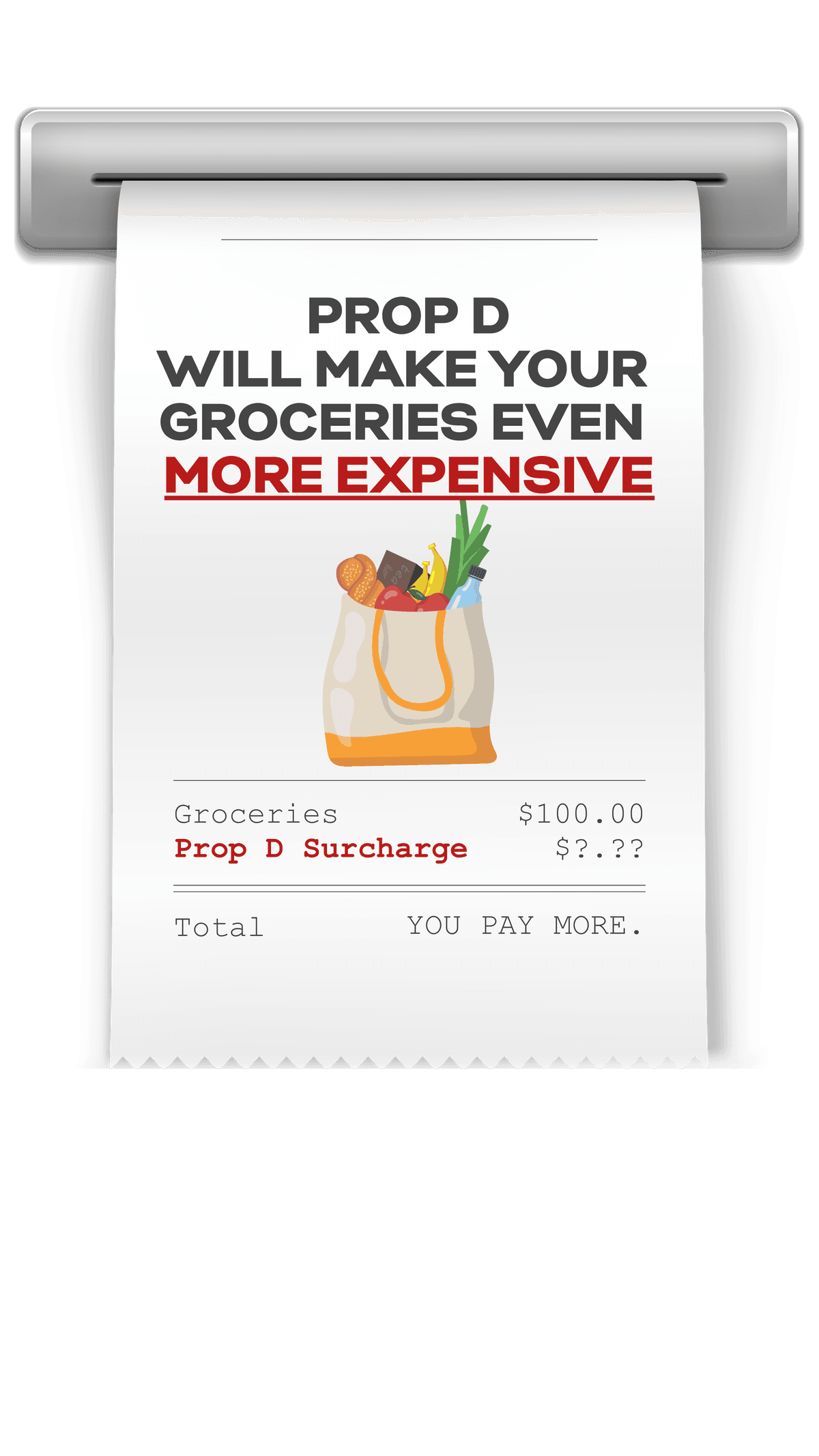
Raising the tax on neighborhood grocery stores by 800% risks driving up the cost of living, pushing out local businesses, and making it harder for stores to stay and operate in San Francisco.
Your grocery bill goes up
Grocery stores can’t absorb an 800% tax increase on 1.3% margins. Up to 40% of the tax gets passed on to you through higher everyday prices.
Your neighborhood store could close
Up to 1,500 San Francisco businesses face pressure to downsize, cut hours, or leave the city entirely.
Store workers lose hours and wages
When stores can’t absorb the tax, they cut staff hours and reduce hiring. Grocery and retail workers face wage losses 7× higher than the citywide average.
Independent analyses all reached the same conclusion.
Multiple independent economic analyses of Prop D agree: it won’t tax CEOs, and it will damage San Francisco’s economy.
944 fewer jobs and $206M less GDP each year, over the next 20 years
Warns the tax “will encourage affected businesses to reduce their tax burden by reducing employment in the city, or by raising prices,” and recommends deferring major business tax changes until SF’s economy stabilizes.
Read the analysis
Editorial Board
May 15, 2026
“Overpaid CEOs won’t pay a cent under S.F.’s Prop D. But you will.” Higher prices on groceries, prescriptions, and everyday goods for the San Franciscans who can least afford them.
Even Prop D’s own sponsor admitted the tax would hit “retail” the hardest.
Read the analysis
May 2026
SF business tax liabilities are already “far beyond other Bay Area cities” and have been “a driving force behind relocations.”
Prop D makes that problem worse.
Read the analysis
April 2026
The tax “doesn’t actually tax CEOs.” Instead, it taxes transactions. 24–40% of the cost gets passed through to consumer prices, and low-margin businesses like grocers face up to 25% profit losses.
How Does Prop D Work?
Prop D doesn’t tax executive pay or corporate profits. It taxes every dollar a grocery store brings in based on how much more a company’s highest paid executive earns than the company’s median worker. Prop D increases the tax rates by more than 800%. For grocery stores, this matters because they already operate on very thin margins. Most of the money from every grocery purchase goes right back into paying workers, rent, utilities, and stocking shelves. Grocery stores often keep just 1–2 cents in profit for every dollar spent. A tax on total sales instead of actual earnings cuts directly into the money stores rely on to stay open and serve their neighborhoods.
Raises Prices for Everyday San Franciscans
When low-margin grocery stores get hit with costs they can’t absorb, they raise prices. Up to 40% of the Prop D tax paid by grocery stores could be passed onto consumers through higher prices. That means more expensive groceries and other everyday essentials. Lower-income families feel these increases the hardest because they already spend a larger share of their income on basic needs. Even small price increases at the checkout line can add up quickly. Programs like SNAP also don’t automatically adjust for higher local costs in San Francisco, meaning families may end up paying more without getting additional support.
Drives Out Businesses and Jobs
Higher prices only cover part of the cost increase, and for grocery stores operating on thin margins, there’s little room to absorb the rest. When grocery stores can’t absorb those costs, they reduce hours, cut jobs, delay expansion, or close locations entirely. Up to 1,500 San Francisco businesses could face serious pressure from Prop D, with grocery and retail stores among the hardest hit. Retail and grocery employees are projected to see wage losses more than seven times higher than the citywide average as stores cut back, reduce hiring, and close locations.
“Don’t let the name fool you, this measure doesn’t tax wealthy CEOs or corporate profits — it’s a tax that will leave consumers picking up the bill at pharmacies and grocery stores.”
Common Questions
What San
Franciscans
are asking
No. The name “CEO tax” is misleading. Prop D does not directly tax CEOs or their personal income. It’s a tax on companies, specifically a tax based on their total sales revenue. It’s a massive increase to an existing San Francisco business tax, and the costs land on employers, workers, and shoppers, not on CEO paychecks.
The name makes it sound like CEOs are footing the bill. They’re not. The tax rate a company owes goes up based on the ratio between its highest-paid executive’s compensation and the median pay of its workers. Prop D would change the comparison base from the median pay of employees located in San Francisco to the median pay of all employees globally, which will significantly lower the median compensation used for the calculation, causing the tax rate to increase dramatically.
In reality, the money comes out of the company’s operating budget, and from there it gets absorbed through some combination of lower profits, higher consumer prices, reduced hiring, and lower wages for other workers.
Companies with large numbers of hourly workers — cashiers, stock clerks, pharmacy techs — naturally have high pay ratios because the median employee earns $30K–$35K. Meanwhile, tech companies where the median employee earns $300K+ have low pay ratios and sail right under the 100:1 threshold.
Yes. Prop D raises the Overpaid Executive Tax from a current max of 0.120% to 1.121%, the highest rate this tax has ever been and an increase of more than 834%, the largest single increase in the tax’s history. A grocery store running on 1–2% margins can absorb a 0.1% tax, but a 1.1% tax would wipe out most of its profit. Walgreens is already closing stores nationwide due to costs and shifting demand, even after tax rates were cut in 2025. Layering the highest rate this tax has ever seen onto already-strained businesses makes closures and relocations more likely.
Yes. For a grocery retailer with a 1.3% net margin, Prop D could consume 20 to 25% of profits and put up to 1,500 SF establishments at risk of downsizing, closures, or relocation. Research shows a 1-percentage-point corporate tax increase makes companies approximately 17% more likely to relocate and reduces new business entry by 6.3%. San Francisco has struggled to retain retailers in recent years even without this tax. Companies do not need to formally leave to reduce their presence. They can close locations, cut staff, or simply choose not to open new locations in SF.
Prop D was put on the ballot through a signature-gathering campaign led by SEIU, a powerful union that works closely with City Hall. They’re telling voters the money will go to healthcare but that’s not actually written into the law. The money would go into the city’s general budget, where it can be spent on anything. There is no guarantee any of the money raised will be spent on health services.
Lower-income families spend a larger share of their income on groceries and essentials, so price increases hit them 3–4 times harder than wealthier households. Programs like SNAP don’t adjust for local price increases, meaning affected families get no additional help to offset higher costs.
San Francisco faces real budget pressures, especially from federal Medicaid cuts. But Prop D is a poorly designed policy. An 800% rate increase across all brackets risks driving businesses out, which could reduce actual revenue collected. A tax that closes grocery stores and drives up prices hurts San Francisco neighborhoods. A poorly designed tax is worse than no tax at all.
The highest rate is 1.12%, but calling it “small” is deeply misleading. This is a gross receipts tax, which means it’s calculated on a business’s total revenue — every dollar that comes in the door — not on profit. A 1% tax on gross receipts is dramatically more burdensome than a 1% income tax. A company with thin margins (say 3–5% profit) could see a huge share of its actual earnings consumed.
No. Economists across the political spectrum have criticized gross receipts taxes for decades. They penalize high-volume, low-margin businesses (like grocery stores) the hardest, they create pyramiding effects that distort the supply chain, and they’re widely considered one of the least efficient ways to raise revenue. There’s a reason most states moved away from them.